The Chevy Chevelle was introduced in August 1963 as a 1964 model built on the General Motors A-Body platform. Available as a convertible, coupe, sedan, wagon, or El Camino pickup, the Chevelle set its sights squarely on the Ford Fairlane. Quickly becoming Chevy’s most popular model, the Chevelle sold 338,286 units for the 1964 model year.

A facelift graced the 1965 Chevy Chevelle, giving it a lower, longer appearance. The front bumper, grille and rear fascia were all redesigned. In the case of convertibles and coupes, the Super Sport, or SS, package is an available option. The Super Sport package comes with SS badging on the rear fenders and trunk lid, rocker panel moldings, black trim on the bottom of the trunk lid and around the taillights, engine design badges on the front fenders, and full wheel covers. The SS also got a standard center console, vinyl bucket seats, SS glovebox door badging, and buyers’ choice of a four-speed manual or two-speed Powerglide automatic.

The 1966 model year brought a clean redesign for the Chevy Chevelle, with curved side windows, new bumpers, grille, muscular curved rear fenders, and the coupe got a new tunnel rear window flanked by flying buttress-style C-pillars. The result is a more muscular and aggressive appearance. Available powertrains included the 283 Small Block, 327 Small Block, or one of three different 396 cubic inch Big Blocks, the most powerful of which produced a whopping 375 horsepower.

The 1967 Chevy Chevelles received a mild facelift that included standard reverse lights and wraparound taillights. All models and trim levels can be ordered with front disc brakes, a folding steering column and available Strato-Ease head restraints. The Chevelle Super Sports is distinguished by its own VIN code which starts with 138.

A complete redesign marked the 1968 Chevy Chevelle, featuring new sheetmetal with more sculpted and curved body lines. The convertible and coupe come with a shorter wheelbase, measuring 112 inches compared to the previous year’s 115 inches. The front and rear tracks are both an inch wider. The roofline on the coupe is more like a fastback. The Concours and SS trims came with Hide-A-Way windshield wipers, a feature that would eventually be rolled out to all trim levels.

For the 1969 model year, the Chevy Chevelle received several aesthetic changes. Parking lights are integrated into the front bumper, and a chrome bar runs across the center of the grille, connecting the headlights. The taillights are larger, but the side marker lights are smaller, as they come from the Camaro. The Chevelle Super Sport came with standard 396 Big Block power, producing 375 horses. The SS package features a dark grille, dark rear panel and dual power domes on the hood. The Chevelle was called “America’s most popular midsize car”, with nearly 455,000 copies sold that model year.

Since displacement was still limited to 400 cubic inches in GM’s midsize passenger cars, the biggest engine you could get in a Chevy Chevelle was a 396… unless you were privy to the Central Office Production Order, or COPO, program. The COPO program is used to order special duty vehicles, such as ambulances, police cars, taxis, or other non-standard cars. It will be built with a heavy-duty electrical system, suspension, cooling system, or whatever the purpose may be. In the case of Camaros, Chevelles, and Novas, COPO means exceptional performance.

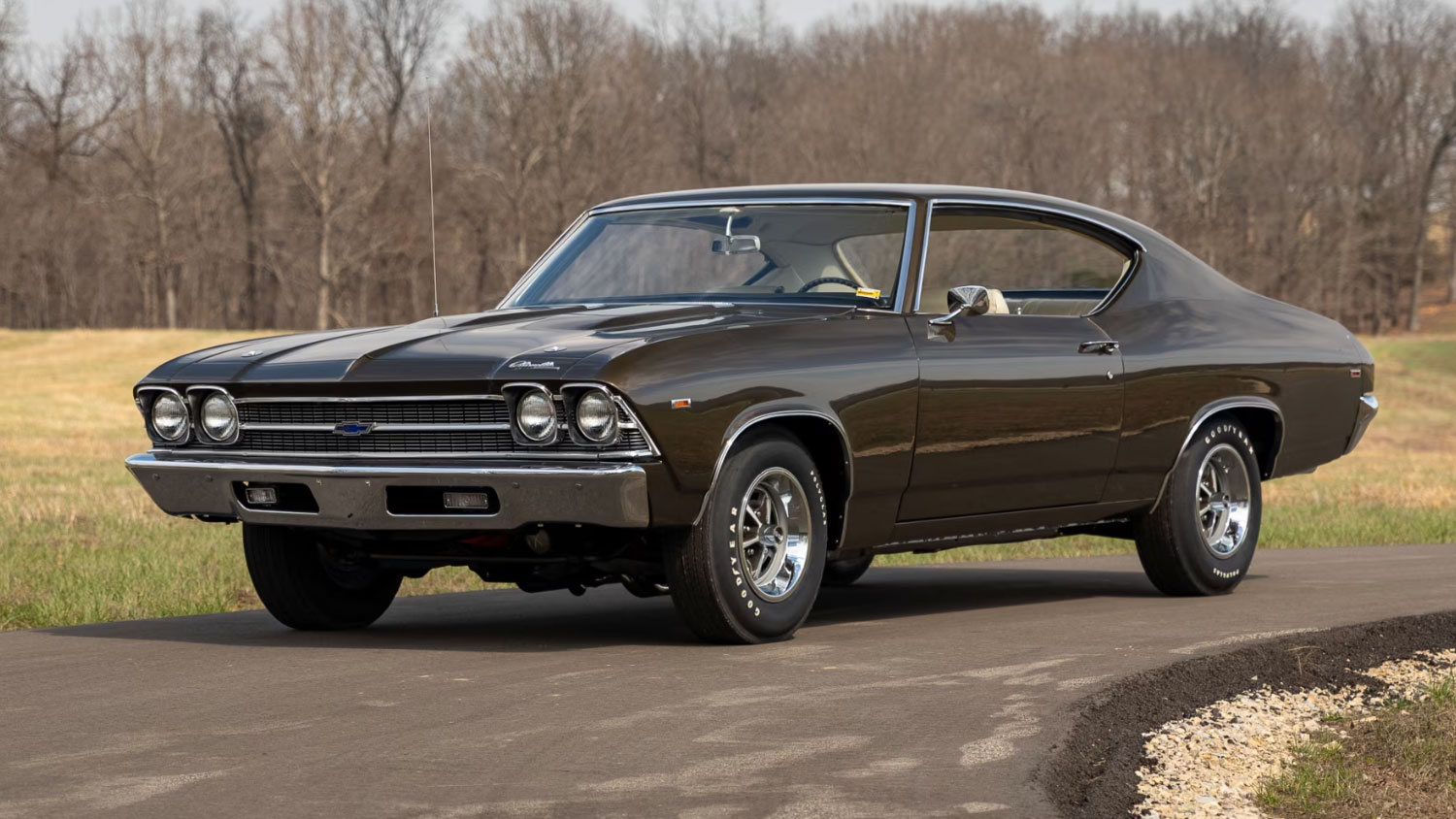
Our feature The 1969 Chevy Chevelle COPO is one of 323 built for the production year, and one of only 96 equipped with an automatic transmission. After being the subject of a frame-off restoration, the Chevelle was finished in Burnished Brown over a Parchment vinyl bench seat interior. Power came from a CE-stamped L72 427 Big Block rated at 425 horsepower (Remember, when the L72 was introduced in the 1966 Corvette, it was rated at 450 horses. When insurance companies balked at that power, Chevy changed the sticker to “425 Horse Power.” They didn’t change a thing.) Backing the 427 was a three-speed Turbo Hydramatic 400 automatic transmission and a heavy-duty COPO KQ twelve-bolt rear end. The Chevelle was equipped with power disc brakes, power steering, auxiliary gauges, push-button radio, and SS wheels with raised white letter Goodyear Polyglas tires. It was originally sent to the Dick Harrell Performance Center in Kansas City for a custom hood lock, headers, carburetor, Sun tachometer, trunk and rear end badges, and tuning before being sold by Bill Allen Chevrolet in North Kansas City. The Chevelle comes with an NCRS Delivery Data Report.

This is rare and amazing 1969 Chevy Chevelle COPO coupe will cross the Mecum Auctions block in its 39th yearth Original Spring Classic in Indianapolis on Saturday, May 16th.
SUBSCRIBE TO GM AUTHORITY
We’ll send you an email or two a day with the latest GM news coverage. It’s completely free.